
A casino is not a place that hopes to win your money. It is a business that has already calculated, to a fraction of a percent, how much of every wager it will keep over time. Slot machines, roulette wheels, card tables, and the new wave of online crash games all run on the same engine: a small, permanent mathematical advantage built into the rules. Individual players win all the time — that’s what keeps the games alive — but the math ensures that across millions of bets, the operator comes out ahead every single time.
The useful thing about this is that the math is no secret. Once you understand three ideas — house edge, expected value, and probability — you can look at any game and see exactly why it favours the house, and why no clever betting pattern can flip that around. That understanding is the most valuable thing in this whole subject, and it’s worth far more than any “system.”
The bottom line, up front
Every real-money casino game carries a negative expected value for the player. That is true of roulette, slots, baccarat, and crash games alike, and it does not change with strategy, bet size, or a lucky streak. The only mathematically honest way to treat gambling is as paid entertainment with a fixed budget you’re prepared to lose — never as a way to make money. If you keep that frame, the rest of this article simply explains why.
House edge: the number that runs every casino
The house edge is the percentage of each bet the casino expects to keep over the long run. Its mirror image is RTP — return to player — which is just 100% minus the edge. A game with a 96% RTP has a 4% house edge: for every 100 units wagered across enough plays, roughly 96 flow back to players and 4 stay with the house.
The figure varies sharply by game, and that variation is itself a lesson. As of 2026, European roulette runs a house edge of about 2.7%, while American roulette nearly doubles it to 5.26% — the only difference being the extra “00” pocket, a single slot that quietly costs players twice as much. Blackjack played with correct basic strategy can fall to around 0.5%. Baccarat’s banker bet sits near 1.06%. Slots are the hungriest, typically ranging from about 2% up to 10% or more, with the exact number hidden inside the math of the reels. None of these edges is large per spin. They don’t need to be — they only need to be positive and to apply to a very large number of bets.
Expected value: why “the long run” always wins
Expected value, or EV, is the average outcome of a bet if you repeated it forever. It’s the tool that turns house edge from a slogan into arithmetic.
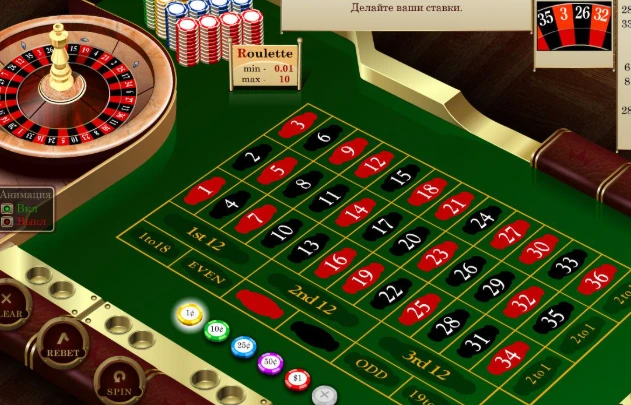
Take a single-number bet on European roulette. There are 37 pockets, you win with probability 1/37, and the payout is 35 to 1. The expected value of a 1-unit bet is (1/37 × +35) + (36/37 × −1), which works out to −1/37, or about −2.7% per bet. That negative number is not bad luck; it is the design. Win or lose on any given spin, the average drags toward a 2.7% loss, and the more you play, the more reliably your real results converge on it. This is the law of large numbers working for the casino: short sessions are noisy and anyone can walk away up, but volume erases the noise and reveals the edge.
The gambler’s fallacy and why streaks lie
The most expensive misunderstanding in gambling is the belief that past results change future odds. After a roulette wheel lands on black nine times in a row, black and red are still equally likely on the next spin. The ball has no memory, the dice have no memory, and a slot’s random number generator has no memory. Each outcome is independent.
Players who chase a “due” colour or a cold machine are reacting to a pattern that doesn’t exist. Independence is precisely what lets the house edge work undisturbed: because no outcome owes anything to the last, the average loss per bet stays fixed no matter what just happened on the screen.
Why betting systems can’t beat the math
Every famous betting system tries to defeat the edge through bet sizing, and every one fails for the same structural reason. The classic is the Martingale: double your bet after each loss so the eventual win recovers everything plus a small profit. On paper it looks unstoppable. In reality, two walls stop it — table limits and your finite bankroll. A short run of losses, which independence makes inevitable, escalates the required bet beyond what you can afford or what the table will accept, and you lose a large sum chasing a tiny one.
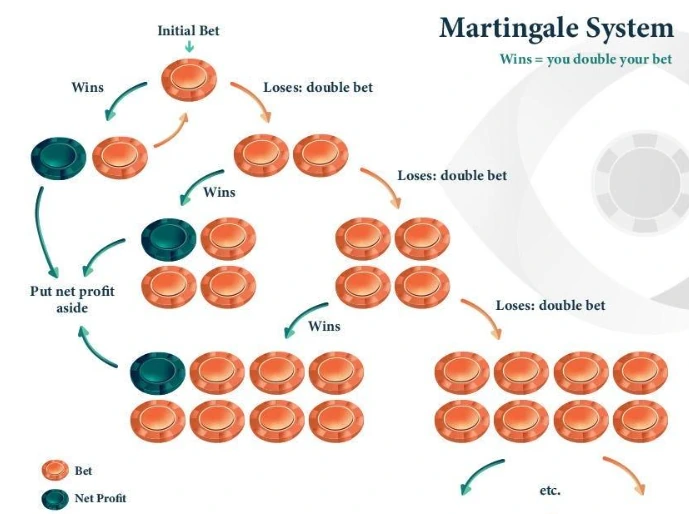
The deeper point is that a system is just a sequence of individual bets, and each of those bets has negative expected value. Adding negative numbers together, in any order or size, never produces a positive total. Bet sizing changes how wild the ride is — the variance — but it cannot change the expectation. That distinction between variance and expectation is the rock that every system breaks on.
Aviator and the new generation of crash games
The same math governs the modern online games that look nothing like a roulette table. Aviator, the crash game by Spribe, is a clean example. A multiplier starts at 1.00x and climbs; you cash out before the plane “flies away” and crashes, keeping your stake times whatever multiplier you locked in. It feels like a test of nerve and timing, but underneath it’s pure probability.
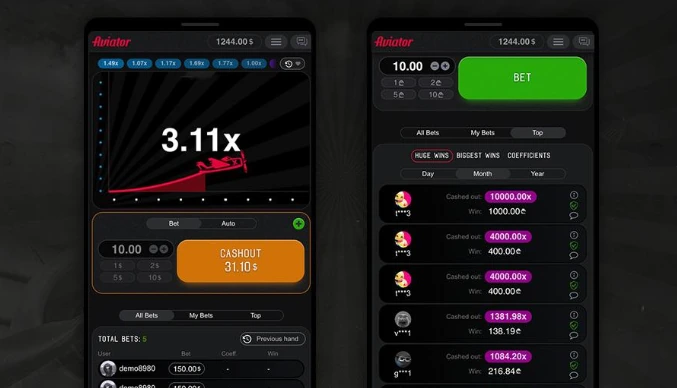
As of 2026, Aviator runs a default RTP of 97%, leaving a 3% house edge, comparable to roulette and better than most slots. The crash point follows a geometric distribution, so the chance the round reaches any multiplier m before busting is roughly 0.97 divided by m. Aiming for 2x gives you about a 48.5% chance, not 50%; aiming for 10x leaves about 9.7%. Around 3% of rounds crash instantly at 1.00x, and that sliver is exactly where the house edge lives.
Here is the part worth sitting with: it does not matter what cashout target you pick. Whether you bail at 1.5x or hold for 50x, the expected return on each unit staked works out to 97% minus 100%, a flat −3%. A low target wins often for small gains; a high target wins rarely for big ones. The risk profile changes completely, but the expected loss is identical. Auto-cashout, “strategies,” and bet patterns shuffle the variance and leave the math exactly where it was.
What “provably fair” actually guarantees
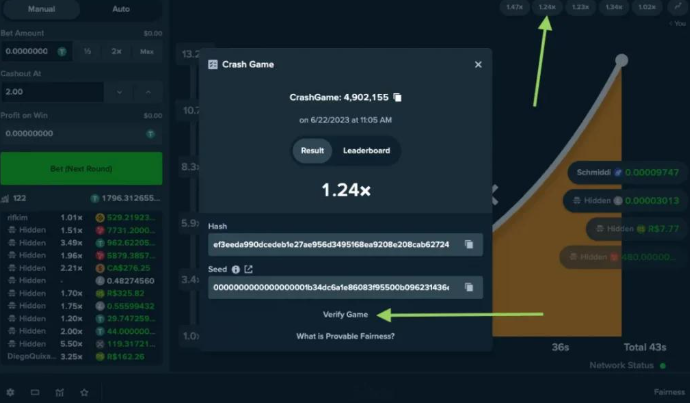
Crash games advertise a “provably fair” system, and it’s a genuine piece of cryptography: the result of each round is committed to a hashed seed before you bet, so it can’t be altered afterward, and you can verify it yourself. That solves the question of whether the game is rigged against the published rules. It does nothing about the rules themselves. A provably fair game with 97% RTP still returns 97 per 100 over time — fairness confirms the house edge is applied honestly, not that the edge is gone. And because every round is mathematically independent, any app or “signal” service claiming to predict the next crash is selling a fiction; if such prediction were possible, it would mean breaking the same encryption that protects banking systems.
The one lesson worth keeping
The genuinely interesting thing about casino math is how openly it works. There’s no trick to expose, because the edge is printed into the rules and confirmed by probability. Roulette, slots, baccarat, and crash games are all variations on a single theme: a transparent, permanent advantage that the law of large numbers turns into reliable profit for the house and reliable loss for the player.
That makes the smart response simple. Treat these games, if at all, as entertainment you’ve already budgeted to lose, the way you’d budget a cinema ticket — never as income, and never with money that matters. If playing ever stops feeling like a choice or starts causing harm, that’s the moment to step back and reach out to a support service for problem gambling. The math is honest about what it’s doing; the healthiest move is to be just as honest with yourself about it.