Ask most people how a card trick is done and they picture nimble fingers — a card slipped to the bottom, a secret palm, hours of practice in front of a mirror. Plenty of magic works that way. But a large and surprisingly powerful family of tricks needs none of it. These are the self-working effects, where the method isn’t a sleight at all but a piece of mathematics that forces the outcome no matter what the spectator does. Learn the principle once, and the trick performs itself.
That’s the quiet appeal of mathematical magic. The maths does the heavy lifting, which frees you to concentrate on the only part that actually fools anyone: the story you tell while it happens. What follows is a tour of the ideas behind some of the strongest self-working tricks, from a false shuffle that mixes nothing to a stacked deck that lets you name a card you’ve never seen.
Why self-working tricks never fail

A self-working trick rests on a mathematical certainty — a calculation, a symmetry, or a property of numbers that holds for every possible input. Because the result is guaranteed, the performer doesn’t need to control the cards in the usual sense. The spectator can choose freely, shuffle, cut, and pick their own numbers, and the maths still funnels everything toward a fixed conclusion.
This is also the trap for anyone learning them. Knowing why a trick works is not the same as being able to perform it. A guaranteed outcome delivered flatly is just arithmetic; the wonder comes from presentation — misdirection, pacing, and a reason for the audience to care. The maths makes the trick reliable. The performer makes it magic.
The false cut: mixing nothing at all
Many self-working effects need certain cards in certain places, an arrangement magicians call a stack. The danger is obvious: if the audience watches you set up the deck, the game is over before it starts. The fix is a false cut, a flourish that looks like a fair mix but leaves every card exactly where it was.
One of the simplest splits the deck into three piles on the table and reassembles them in an order that just undoes the split. Cut a portion off to the right, cut another beyond it, then gather the piles so each section returns to its original spot. To anyone watching, it’s a casual gambler’s cut. In reality it’s pure bookkeeping — three groups taken apart in one sequence and put back in the reverse, so the order never changes. Done while chatting, with your eyes on the spectator rather than the cards, it sells the idea that the deck is being shuffled when nothing has moved.
1089: the prediction that’s already written
Here’s an effect you can do with any pen-and-paper spectator and a sealed prediction. Ask them to write a three-digit number where all the digits differ and the largest sits first. Have them reverse it and subtract the smaller from the larger. Then have them reverse that result and add the two together. Whatever they started with, the final total is 1089 — the number you predicted before they wrote anything.
The “make the digits different, biggest first” rules sound like extra difficulty. They’re actually the conditions that make the algebra behave. Treat the number as hundreds, tens, and units, and work the subtraction with a careful borrow: the tens column always lands on 9, and the outer digits always add to 9. Reverse the result, add, and the whole thing locks to 1089 every single time. The presentation disguises this by selling the constraints as a way to make the outcome “more impossible,” when they exist purely to keep the maths on rails.
Lightning addition with a Fibonacci shortcut
This one looks like superhuman arithmetic. Have a friend write any two two-digit numbers at the top of a column, then build a chain where each new number is the sum of the previous two, until there are ten numbers. The instant they finish, you announce the total of all ten — faster than they can add it on a phone.
The secret is that you never add anything. A chain where each term is the sum of the two before it is a Fibonacci-style sequence, and such a chain hides a tidy property: the sum of the first ten terms always equals exactly eleven times the seventh term. So while your friend is still writing, you glance at the seventh number and multiply it by 11.
The fast multiply-by-11 it leans on
Multiplying by 11 in your head is its own small piece of magic. For a two-digit number, pull the digits apart and drop their sum into the gap. For 11 × 72, picture 7_2, add 7 + 2 = 9, and slot it in the middle to get 792. If that middle sum hits double digits, carry the extra one into the left digit. The reason is plain once you write it out: multiplying by 11 is multiplying by 10 and adding the number again, which places the digit-sum neatly in the tens column. Combine it with the Fibonacci shortcut and you can total ten numbers before anyone has finished typing the first three.
Reading a “memorised” deck with binary
For this effect you appear to flash-memorise half a shuffled deck, then “recall” cards by position. The real work is done by four cards hidden beforehand: the Ace of Clubs, Two of Hearts, Four of Spades, and Eight of Diamonds — values 1, 2, 4, and 8. Those four numbers are the building blocks of binary, and any value from 1 to 13 can be assembled by adding some combination of them.
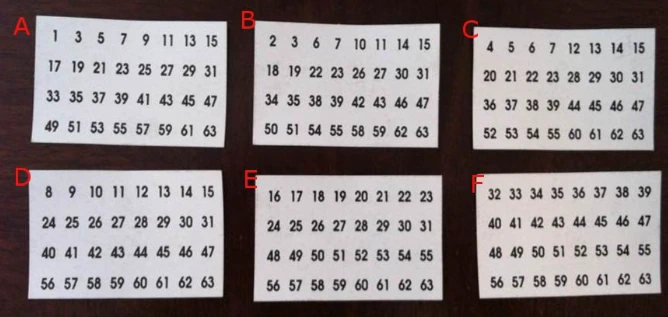
When a spectator names a card, the suit comes from a fixed cyclic suit order you’ve memorised, and the value comes from binary. A six is four plus two, so you produce the cards adding to six. A King, worth 13, is eight plus four plus one. Because every card value has a single unique binary breakdown, a secret stack of just four cards can “reconstruct” any card on demand. It feels like memory; it’s the same place-value system that stores every number inside a computer.
Finding a card at any number with base-3
Take 27 cards, let a spectator pick one, lose it in the packet, and name their favourite number from 1 to 27. After some theatrical talk about narrowing the options, their card surfaces at exactly that position. Twenty-seven isn’t a random size — it’s three cubed, and that’s the giveaway.
Deal the cards into three piles, three times over. Each round, the spectator tells you which pile holds their card, and each round you gather the piles in a chosen order, placing the key pile on top, in the middle, or at the bottom. Those three placements are the three digits of a base-3 number, and ternary counts in units, threes, and nines rather than units, tens, and hundreds. By deciding where the pile lands on each of the three deals, you’re writing the target position in base 3 and steering the card straight to it. All the patter about memorising and shrinking the odds is cover for a single clean idea.
Sorting by primes without looking
Hand half the deck to each of two spectators, let each pick a card, swap them, bury them, and shuffle — yet you find both chosen cards in seconds. The setup is a quiet sort done in advance: every card with a prime value (2, 3, 5, 7, plus Jack and King at 11 and 13) goes in one half, every non-prime in the other. After the swap, the only prime sitting among the non-primes, and the only non-prime among the primes, are the chosen cards. Spotting the one value that doesn’t belong is far easier than tracking a shuffled deck, and the audience never suspects the pack was grouped by a number property at all.
The stacked deck and clock arithmetic
The most professional self-working tools are full-deck stacks: orders that look random but let you name any card from a single glimpse. A classic is the Si Stebbins stack, where the suits run in a fixed repeating cycle and each card’s value is three higher than the one before it. Glance at the bottom card and you immediately know the one cut to the top — add three to the value, step the suit forward one place, and you’ve named a card you never saw.
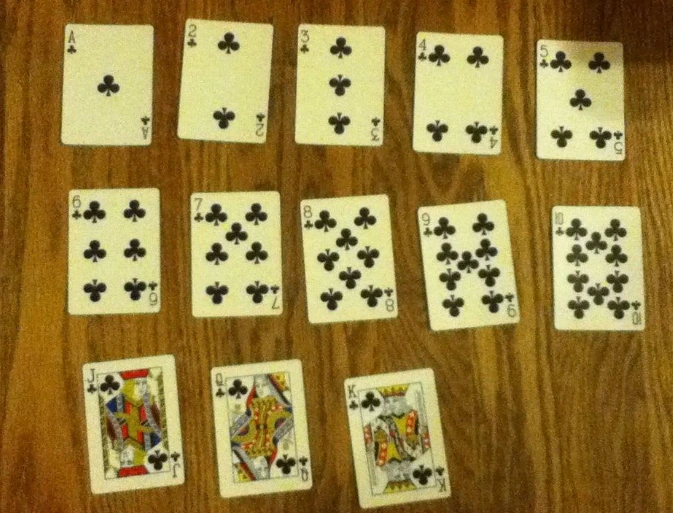
This runs on modular arithmetic, the “clock” maths where numbers wrap around. A twelve-hour clock returns you to the start after twelve steps; the card values behave like a clock with thirteen positions, looping from King back to Ace, while the four suits cycle on a separate four-position clock. Track both wheels and you can work out the suit and value at any position in the deck. The same wrap-around arithmetic that hides a card’s identity powers the encryption protecting online payments — a reminder that a “trick” and a serious tool can be the very same idea in different clothes.
Where the maths goes after the trick
None of these effects is a dead end. The binary stack is the language computers think in. The clock arithmetic behind a stacked deck secures bank transfers and phone calls. The probability quietly holding up a “think of a number” stunt is the same maths insurers and scientists rely on daily. A self-working trick is, in a real sense, a small demonstration of why mathematics matters — wrapped in a story built to astonish rather than to teach.
That points to the practical lesson for anyone who wants to perform them. Pick one or two effects and learn the principle until you could rebuild it from scratch, because understanding beats rote memory the moment something goes slightly off. Then pour most of your effort into the presentation — the patter, the pauses, the misdirection that lets the maths work unnoticed. The calculation guarantees the result; everything an audience walks away remembering comes from how you wrap it. Get both halves right, and a single line of arithmetic turns into a genuine moment of wonder.